
Have you ever had one of those quiet moments—maybe staring at the ceiling at 3 a.m.—when the question hits: “Who am I, really?” Not the surface stuff like your job title or the last argument with your partner, but the core of you. That’s the spark Jnana Yoga ignites. It’s not about twisting into pretzel poses or chanting for hours (though those have their place). Jnana Yoga is the path of knowledge, the yoga of wisdom, where you use your mind to cut through illusion and discover the unchanging truth beneath everything. It’s intellectual, introspective, and honestly, one of the toughest paths because it demands you question everything you’ve taken for granted.
I remember the first time I seriously tried it. I sat down, closed my eyes, and asked “Who am I?” My brain immediately fired back: “You’re the guy who forgot to pay the electric bill.” Classic ego deflection. But stick with it, and something shifts. You start peeling away layers, and what remains is pure awareness. That’s Jnana Yoga in a nutshell.
What Is Jnana Yoga?
Jnana Yoga, sometimes spelled Gyana Yoga, translates from Sanskrit as “the path of knowledge.” Jnana means wisdom or higher knowledge—not trivia or book smarts, but direct realization of the Self (Atman) as one with ultimate reality (Brahman). It’s about discerning what’s eternal and unchanging from what’s temporary and illusory (maya).
Unlike physical yoga styles, Jnana doesn’t involve asanas. It’s mental and philosophical, rooted in Advaita Vedanta (non-dualism). The goal? Liberation (moksha) through understanding that you are not your body, mind, or ego—you are the witness consciousness behind them.
The Origins and Philosophy of Jnana Yoga
Jnana Yoga traces back to the Upanishads, ancient texts from around 800–200 BCE, where sages explored the nature of reality through deep inquiry. The Bhagavad Gita dedicates chapters to it—Chapter 4 is literally “Jnana Karma Sanyasa Yoga,” blending knowledge with action.
Adi Shankara, the 8th-century philosopher, systematized it in Advaita Vedanta, teaching that the individual self and universal Self are identical. Ramana Maharshi modernized it with his famous “Who am I?” inquiry.
The core philosophy: everything that changes—thoughts, emotions, body—is not the real you. The real you is Sat-Chit-Ananda: existence, consciousness, bliss. Maya makes us mistake the rope for a snake in the dark. Jnana removes that ignorance.
The Four Pillars of Jnana Yoga
Adi Shankara outlined four prerequisites (Sadhana Chatushtaya) before diving deep. Without these, the mind stays too restless.
Viveka (Discrimination)
This is the ability to tell real from unreal, permanent from impermanent. Ask: Does this change? If yes, it’s not the Self.
Vairagya (Dispassion)
Detachment from worldly things. Not cold indifference, but freedom from craving. You enjoy life but aren’t enslaved by it.
Shatsampatti (Six Virtues)
These stabilize the mind:
- Shama: Mental calm
- Dama: Sense control
- Uparati: Withdrawal from distractions
- Titiksha: Endurance
- Shraddha: Faith in teachings
- Samadhana: Concentration
Mumukshutva (Longing for Liberation)
Intense desire for freedom above all else. When this burns strong, the other pillars fall into place.
Core Practices of Jnana Yoga
The classic three-step process is Sravana, Manana, Nididhyasana.
Sravana (Hearing or Study)
Listen to teachings from scriptures (Upanishads, Gita) or a qualified teacher. Read, discuss, absorb.
Manana (Reflection)
Think deeply. How do these truths apply to your life? Challenge your beliefs.
Nididhyasana (Meditation/Contemplation)
Meditate on insights until they become direct experience. Focus on Mahavakyas like “Tat Tvam Asi” (Thou art That).
The heart of practice is self-inquiry. Ramana Maharshi’s method: Ask “Who am I?” relentlessly, tracing thoughts back to their source.
How to Practice Jnana Yoga in Daily Life
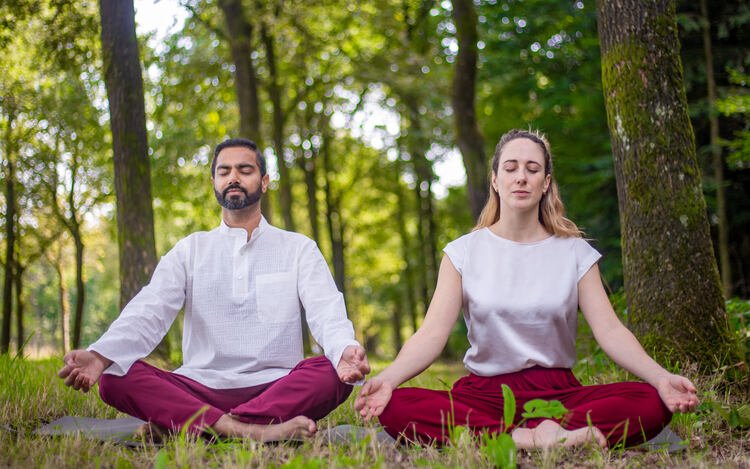
Start small. Dedicate 20 minutes daily to quiet reflection. Sit comfortably, close your eyes, and ask “Who experiences this thought?” Watch the mind without getting lost in it. When life gets chaotic—traffic, deadlines—pause and inquire: “Who is upset?” It creates space.
Combine with other paths if pure Jnana feels too dry. Karma Yoga purifies action, Bhakti softens the heart. Many blend them.
Humor helps: I once spent an entire commute asking “Who is stuck in this jam?” The ego screamed “Me!” but the witness just observed. Tension dropped. Try it—your road rage might thank you.
Jnana Yoga vs. Other Paths of Yoga
Yoga offers four main paths, each suiting different temperaments.
| Path | Focus | Best For | Key Practice | Difficulty |
|---|---|---|---|---|
| Karma Yoga | Selfless action | Active, service-oriented | Work without attachment | Medium |
| Bhakti Yoga | Devotion | Emotional, heartfelt | Prayer, chanting, surrender | Easier |
| Jnana Yoga | Knowledge & inquiry | Intellectual, analytical | Self-inquiry, contemplation | Hardest |
| Raja Yoga | Meditation & control | Disciplined, introspective | Ashtanga (8 limbs) | Medium-Hard |
Jnana appeals to thinkers but demands razor-sharp discrimination. Bhakti feels warmer; Karma more practical.
Pros of Jnana Yoga:
- Leads to profound self-realization
- Builds mental clarity and resilience
- Reduces suffering through understanding illusion
- Lifelong growth without needing external rituals
Cons:
- Can feel dry or isolating
- Ego resists fiercely
- Risk of intellectual arrogance
- Requires patience—results aren’t quick
People Also Ask
What is Jnana Yoga in simple words?
It’s the yoga of wisdom, where you question “Who am I?” to realize you’re pure consciousness, not your thoughts or body.
Is Jnana Yoga the hardest path?
Many say yes—it’s intellectual and relentless. But if your mind loves analysis, it might feel natural.
Can beginners practice Jnana Yoga?
Yes, start with simple self-inquiry. But study with guidance to avoid confusion.
What’s the difference between Jnana and Raja Yoga?
Raja focuses on mind control through meditation steps; Jnana uses inquiry to transcend the mind altogether.
Who is a famous Jnana yogi?
Ramana Maharshi—his “Who am I?” method transformed countless lives.
FAQ
How long does it take to see results from Jnana Yoga?
It varies. Some feel shifts in weeks; full realization can take years or lifetimes. Consistency matters more than speed.
Do I need a guru for Jnana Yoga?
Highly recommended. A teacher prevents getting lost in concepts. Self-study works, but guidance accelerates progress.
Can Jnana Yoga help with anxiety?
Yes—by questioning “Who feels anxious?” you detach from the emotion, reducing its power.
Is Jnana Yoga compatible with modern life?
Absolutely. You can practice during commutes, work breaks, or walks. It’s internal, not lifestyle-dependent.
What’s a good starting book?
“Be As You Are” by Ramana Maharshi (edited by David Godman) or “The Crest-Jewel of Discrimination” by Adi Shankara.
Jnana Yoga isn’t for everyone, but if something in you hungers for truth beyond appearances, it can change everything. Start today—ask the question. Who knows? You might discover the answer was there all along.